
The short answer
Sagging doors usually need their support and alignment put right; a door rubbing after new flooring may instead need clearance restored. Uneven cupboard gaps, paint sticking at contact points and a sliding panel catching in its track are different faults. The pattern of the problem helps identify whether adjustment, fixing repairs, replacement hardware or work to the finish is appropriate.
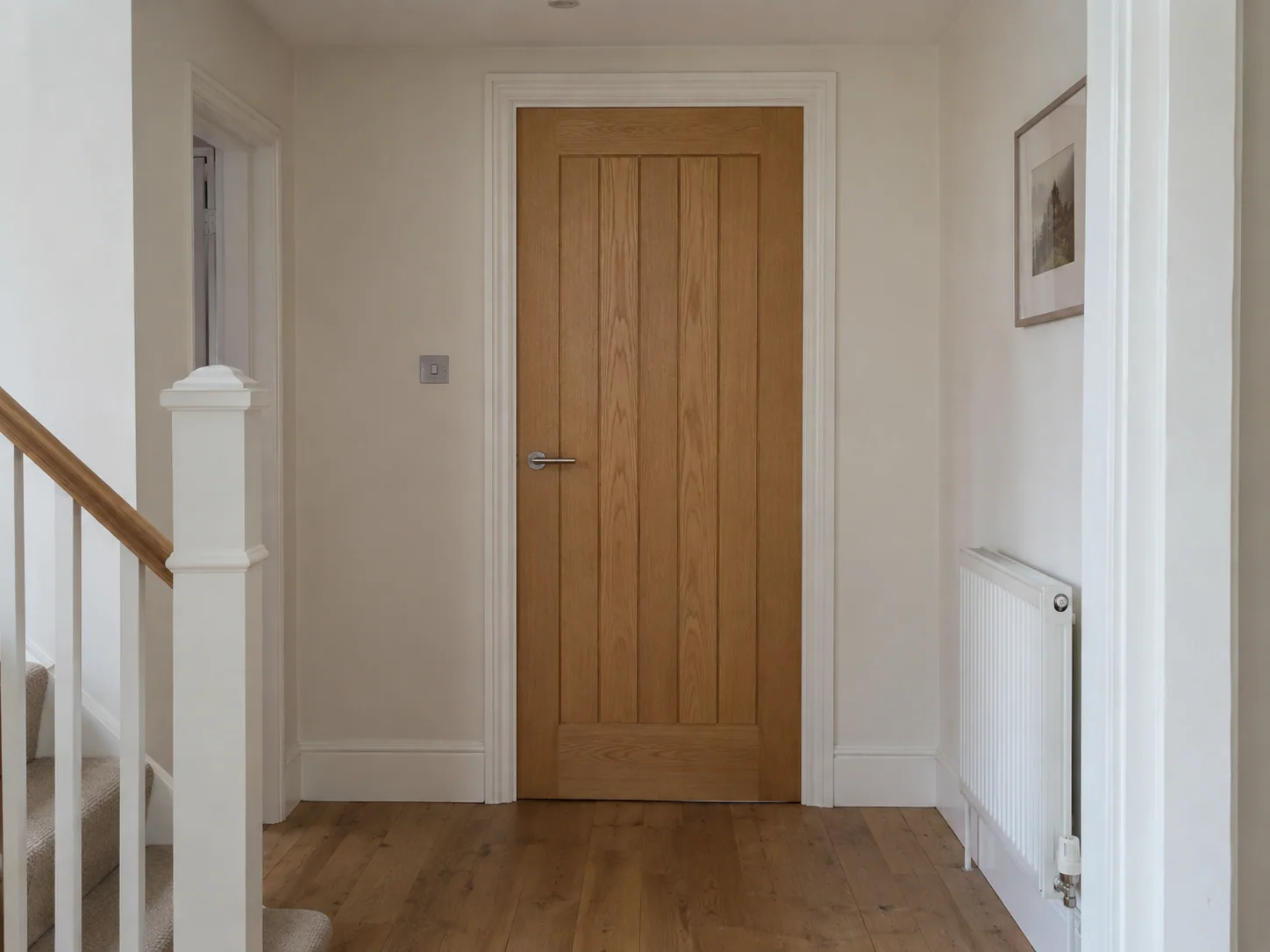
A cupboard door that hangs crooked, a wardrobe door that catches or a room door that no longer closes does not automatically need replacing. The problem may be an adjustment, worn hardware, a damaged fixing or a change in the door's fit.
The important question is what has caused it. A new hinge will not solve every uneven gap, and trimming a door can be unnecessary if its support needs correcting.
ThamesTask helps with sticking internal doors, cupboard fittings, loose handles and other small repairs around the home. You do not need to identify the mechanism or buy replacement parts before asking about a job. Tell us what is happening, including any other repairs you would like considered at the same time.
What are the most common door problems?
Door problems usually show up as a change in movement or alignment: the door drops, rubs, sits unevenly, becomes difficult to move or stops staying closed. Similar symptoms can come from different causes, especially when comparing cupboards, hinged wardrobes, sliding wardrobes and room doors.
| Problem | Possible causes | What the repair may involve |
|---|---|---|
| Uneven cupboard or wardrobe doors | Hinge settings, loose mountings or cabinet alignment | Adjustment or repairing the supporting connection |
| Door hanging low or at an angle | Movement or wear in its support | Restoring secure fixings, correcting the fit or compatible hardware replacement |
| Door catches the frame or floor | Changed alignment, reduced clearance or coating build-up | Addressing the cause before deciding on a fit adjustment |
| Door will not latch | Latch misalignment or a hardware fault | Correcting the door position or repairing compatible latch hardware |
| Sliding wardrobe door drags or jumps | Obstruction, guides, running gear or track problems | System-specific adjustment, cleaning or compatible component repair |
| Door sticks after decorating | Tight contact or a coating/contact-material problem | Appropriate fit and finish work |
Those are repair possibilities, not diagnoses from a symptom alone. A useful assessment looks at the surrounding cabinet or frame as well as the affected door.
Different doors have different support systems
Concealed cabinet hinge
Cupboard and hinged wardrobe doors may use adjustable hinges. The hinge, mounting plate and board attachment all matter.
Hinged room door
The leaf is supported at its side by hinges fixed to the frame. Loose attachment and worn hardware can both affect alignment.
Sliding wardrobe door
Tracks, guides and rollers control movement. The load may be carried at the top or bottom, depending on the system.
Simplified component examples, not adjustment instructions. Hardware and hinge quantity vary.
If a panel feels insecure or is coming out of its track, leave it alone and keep the opening clear while the problem is assessed.
Why are my cupboard doors uneven or sagging?
Cupboard doors can look uneven because a sound hinge is set incorrectly, its attachment has loosened or the cabinet has moved out of square. A door sitting evenly lower than its neighbour suggests a height issue. A gap that widens from top to bottom suggests an angle issue. Loose hardware or damaged board needs repair before alignment will stay consistent.
The timing helps distinguish these possibilities. A neat gap that has gradually changed raises a different question from a newly assembled run that has never lined up. If several fronts lean in the same direction, the cabinet position deserves attention as well as the individual hinges. These are clues to the source of movement, not proof that a particular screw needs turning.
The surrounding furniture matters too. A cabinet that is leaning or out of square can prevent a neat run of doors, even when the hinges are adjustable. 1 That is why a dropped door is worth considering as part of the whole unit rather than only as one hinge that looks low.
How are kitchen cupboard doors adjusted?
Many concealed hinges allow the door to move up or down, sideways, and nearer to or farther from the cabinet. The available adjustment depends on the hinge and mounting plate. 2
Height adjustment addresses a front that sits too high or low. Side adjustment changes the relationship to the neighbouring door or cabinet edge. Depth adjustment changes how far the front sits from the cabinet. Those movements can interact, especially on a tall wardrobe door with several hinges, so matching one corner alone may leave another edge catching.
The aim is a door that works properly, with a consistent fit, rather than a gap that looks right only while the door is being pushed into position. Our small repairs and carpentry service includes cupboard-door and hinge adjustments.
Why will my cupboard or wardrobe door not close flush?
A door that stands proud may meet an obstruction, have its hinge depth set incorrectly or have a twisted panel or cabinet. If it reaches the closed position freely but opens again, the catch or closing mechanism becomes a more useful starting point. If it physically meets a shelf, another door or the cabinet edge, the fit needs correcting first.
A whole front sitting evenly forward is different from one corner protruding while the opposite corner is flush. The first points towards depth or closing position; the second also raises panel or cabinet alignment. Repeatedly pulling the handle harder will not correct either. The repair can be a setting change, restoring secure mountings or replacing a failed catch, rather than replacing the complete door.
Tell us whether one corner protrudes, the whole edge sits forward or the door meets another panel. You do not need to know the name of the hinge to describe the problem.
Why is my soft-close hinge not working?
Soft-close slows the final movement; it is not the same function as the spring or mechanism that pulls the door shut. A door can therefore stop short because of alignment or an obstruction even when the damper itself works.
A door that travels normally but now slams at the end has lost the slowing effect. A deactivated damper and a failed damper can produce that symptom; some hinge systems have a deactivation setting. 15 A door that grinds or rubs before reaching the final movement points to an additional fit or hardware problem.
If it stops short of closing, the door fit, an obstruction or the closing mechanism may be responsible instead. Different hinge systems combine closing and damping functions in different ways. 3 The repair should address the function that has actually changed.
Replacing every hinge is not automatically necessary. The useful starting point is whether the door moves normally and what changes during the last part of closing.
Can a loose cupboard hinge be repaired?
A loose cupboard hinge can often be repaired when the door and cabinet still provide a sound place to support it. A plate moving against otherwise intact material, a worn hinge joint and a hinge torn out with a piece of board are different failures. They call for securing the connection, replacing the hinge or repairing the mounting area respectively.
Reinforcement plates can be an option for local damage when they bridge to sound material and suit the hinge position. They cannot make extensively crumbling, split or swollen board sound again. Replacement of the affected door or cabinet part becomes more relevant when a secure attachment cannot be restored. The size of the damaged area matters more than whether a plate can hide it.
We can review the existing fitting and any replacement parts you already have before agreeing the work. There is no need to order a selection of parts and hope that one solves the problem.
Why is my internal door sticking or catching?
An internal door catches when part of the door or its hardware meets something it should clear. The main possibilities are changed alignment, insufficient space around the edges, a finish that sticks or a latch that misses its opening. Where the contact occurs, and what changed before it started, help separate those problems.
Rubbing during the swing is different from a click or knock only at the latch. A door that becomes harder to move after new carpet presents a different question from one that gradually hangs lower. Repairing a loose support can restore the original clearance; trimming first can leave an unnecessary gap once the door is hanging correctly again.
Mention whether the problem appeared after decorating, new flooring or another alteration. That context helps us understand what changed and what the repair is likely to involve.
How do you fix a sagging door?
A sagging door is repaired by restoring secure support and the correct position in its opening. Sound hinges with loosened attachments may need securing; damaged fixing points need a sound mounting repair; a worn or distorted hinge may need replacement. Removing timber from the rubbing edge does not repair a door that is still dropping.
A changed top gap together with a low latch-side corner is consistent with the door rotating out of its original position. Movement at a hinge plate points towards the attachment; play within a firmly attached hinge points towards the hinge itself. Both can lead to sagging, but replacing a hinge will not fix a damaged mounting area. Manufacturer troubleshooting treats loose hardware, alignment and fit as separate possibilities. 4
For a door that has gradually become harder to use, putting the support right is more useful than repeatedly treating the new rubbing point.
Why is my door catching at the top or side?
A door catching near one corner, with a gap that tapers around the opening, suggests an alignment issue worth checking before trimming. Broad contact along an edge can instead reflect an overly tight fit, paint build-up or moisture-related movement. A rubbing mark locates the contact; it does not prove that the nearest edge is the part that needs cutting.
| Visible pattern | Useful distinction | Repair direction |
|---|---|---|
| One corner rubs and the surrounding gap tapers | The door or frame may be out of alignment | Check the support and opening before altering the edge |
| A longer edge rubs, especially after decorating | Restricted clearance and coating contact need separating | Correct the fit or finish that is causing the contact |
| The door binds near the hinge side at the end of closing | Hinge seating or contact at the stop can prevent full closure | Correct the closing geometry, rather than only moving the latch |
| Only the bottom rubs after flooring changes | The available floor clearance may have reduced | Consider the new floor level and any permitted door adjustment |
These are starting points, not a diagnosis from the gap shape alone. A door that has always rubbed may have been fitted too tightly; one that worked for years may have developed loose support, a finish problem or movement in the opening. A progressive change affecting several doors, especially with new cracks, needs the wider cause considered rather than repeated local trimming.
What the gap pattern can tell you
Even gaps
An even outline is a useful reference. It does not, on its own, prove that the hinges, latch or door are sound.
A gap that narrows
A wedge-shaped gap is a clue to alignment or support movement. Check the hinge attachment and frame or cabinet position.
A local rubbing point
The contact position helps narrow the cause. Recent paint, changed floor clearance or movement can need different repairs.
Exaggerated for clarity. These are observations to compare, not diagnoses or target gap dimensions.
Why is my door scraping the floor?
A door scrapes the floor when it has dropped or the space below it has reduced. If the problem began immediately after new carpet, underlay, tiles or flooring, the new floor height is a useful starting point. If the latch has also moved and the upper gaps have changed, support and alignment deserve attention first.
Where a fit adjustment requires trimming, the door's construction and remaining allowance matter. Manufacturers set limits for particular doors, and previous trimming can affect what remains possible. 6 A veneered or engineered door should not be treated as an unlimited piece of solid timber.
Rubbing only over one part of the swing can also reflect the floor's profile rather than a uniformly low door. The repair needs to leave the door usable throughout its movement. Explain whether the entire bottom edge catches or only one corner, and whether any flooring work coincided with the change.
Why does my door stick in damp weather?
Wood can swell, shrink or distort as its moisture condition changes. Door-care guidance identifies moisture exchange as a cause of movement, so it is one possible explanation for a fit that changes over time. 7
That does not mean every sticking door is swollen or that every distorted door will recover when conditions change. Persistent damp or other deterioration needs its cause understood before a cosmetic adjustment is agreed.
The repair may also involve restoring the appropriate finish after permitted work. Depending on the door, exposed edges and cut-outs can matter as well as its visible faces. 8
Why is my door sticking after painting?
A door can stick after painting because the added coating reduces an already tight gap, or because painted contact surfaces adhere to one another, known as blocking. A door that rubs whenever it moves suggests a clearance problem. One that moves freely once released but sticks again after being left closed is more consistent with a contact or coating problem.
A coating that feels dry is not necessarily ready for prolonged contact under the actual conditions. Blocking guidance therefore refers back to the selected paint and its instructions. 9 There is also an important exception: Dulux Trade's UK guidance notes that some door seals can stick even to dried and cured paint. 10
The repair choices are correspondingly different: restoring adequate clearance, allowing the specified coating development under suitable conditions, or correcting an unsuitable finish or contact material. Our paint drying, recoating and curing guide explains why a touch-dry surface is not automatically ready to stay pressed against another surface.
If the repair includes damaged or unsuitable paintwork, we can discuss the relevant painting and decorating work alongside the door adjustment.
Why does my door close but not latch?
A door that closes but will not latch usually has a mismatch between the latch and its opening in the frame, or a fault in the handle or latch mechanism. If the door also hangs low or rubs, its position may be the cause. If it sits correctly but the latch does not move or return normally, the hardware becomes the stronger lead. 4
A latch meeting metal above or below the opening is an alignment problem; a door that cannot reach the frame stop may have a fit problem before the latch is involved at all. Correcting the door's position, adjusting the keep and replacing a worn latch are different repair options. Moving the keep to follow a door that continues to sag leaves the original cause in place.
Tell us whether it catches on the way in, needs lifting to close or reaches the closed position and then opens again. Those descriptions help distinguish the work required.
Why does my door swing open or closed by itself?
An ordinary internal door that consistently drifts the same way in still air may have a hinge line that is not vertical. Air movement or a fitted closer can also move a door. Installation alignment is a recognised cause of a door opening by itself. 4 A repair therefore needs to distinguish unintended drift from the closing function the door is supposed to have.
Where a door has a fire-protection or specialist function, its required hardware and closing performance need appropriate assessment. 11 ThamesTask's general small-repair information is not a promise to modify certified or security doors.
Why are my sliding wardrobe doors sticking or uneven?
A sliding wardrobe door that feels rough throughout its travel may have a running-gear, guide or track problem. A catch at one repeatable position points towards a local obstruction, damaged track or contact between panels. A door that moves smoothly until the final closing stage raises a different question about its end position or soft-close mechanism.
Some systems are supported on bottom rollers with separate upper guides; others use a different arrangement. 12 That means a dragging panel is not automatically repaired in the same way as another wardrobe that looks similar.
These distinctions narrow the enquiry without requiring you to remove a heavy panel. A worn roller travels with the door; a dent or obstruction in a track stays in one place. Either can disrupt movement, and more than one fault can coexist. The table describes possible explanations rather than proving which component has failed.
| When the problem happens | What it can suggest | Possible repair |
|---|---|---|
| Rough or noisy through much of the travel | Contamination, worn running gear or ongoing guide contact | System-appropriate cleaning, alignment or replacement running parts |
| A catch at one repeatable position | A local track defect, obstruction or panel-to-panel contact | Remove the cause of local contact or repair the affected track or fitting |
| Smooth travel, then stops short or slams at the end | Closing-device engagement or end-position setting | Correct the setting or replace a failed closing component |
| Uneven side gap but otherwise smooth movement | Panel height or opening alignment | Correct panel alignment within the system's available adjustment |
Track cleaning, height adjustment, soft-close faults and retention faults are separate categories in Spacepro's troubleshooting guidance. The exact system still determines how each repair is performed. For sliding or mirrored panels, we confirm the fittings and scope before arranging work.
Why will a sliding wardrobe door not close properly?
A sliding door can stop short because something physically blocks it, because its position is wrong or because the soft-close device does not engage correctly. A panel that finishes at an angle suggests a height or opening-alignment issue. A panel that remains parallel but no longer slows or draws in during the final movement makes the closing device more relevant.
Some closing mechanisms can need resetting or adjustment; a damaged mechanism needs the correct replacement rather than more force. A cracked or distorted track requires a different repair again. Correcting one symptom does not confirm that the panel is securely retained, so the running and retention arrangements belong in the same job review.
For an uneven gap, the surrounding opening and track installation also matter. Adjusting one panel is not necessarily enough if its supporting arrangement is damaged.
Why does my sliding wardrobe door keep coming off the track?
The running gear, guides or retention features may need attention. Anti-jump arrangements are part of particular systems and should not be treated as optional components. 14
A panel that repeatedly leaves its track is an assessment issue, not something to keep putting back while continuing normal use. Leave an unstable panel alone and keep people clear.
A worn wheel, damaged guide or missing retention component can call for part replacement; a sound but incorrectly set system may need adjustment. Returning the panel to the track without resolving why it left is not a complete repair. Identify the wardrobe system from an order record or visible label if available; there is no need to lift the panel to photograph hidden fittings.
Can the door be repaired, or does it need replacing?
Repair is usually worth discussing when the door panel and its supporting structure are sound and the fault is confined to adjustment, a mounting point or replaceable hardware. Replacement becomes more relevant for substantial distortion, split or swollen material, extensive mounting damage or a system whose essential parts cannot be obtained.
Compare the complete work, not only the price of a hinge or replacement panel. A repair may include reinstating the mounting and touching up the finish. A replacement still needs fitting to its installation instructions, appropriate hardware and any required decoration. 5 Restoring the existing door can avoid unnecessary replacement, while repeatedly adjusting a failing component can turn a small repair into recurring work.
For furniture that has been assembled recently or moved, the door can also be considered with the surrounding unit. Our furniture assembly service explains the broader assembly work we offer.
How much does a door adjustment or repair cost?
The cost depends on the cause, the number of affected doors, any replacement parts and whether finishing work is needed. An alignment adjustment and a damaged mounting repair are not the same job.
Tell us about the complete list. A sticking room door, an uneven cupboard and a loose handle may be suitable to plan together, depending on the scope and parts required. We can discuss what can be grouped into a visit rather than asking you to make separate enquiries for each small problem.
Our pricing information explains what helps us prepare a quote. We agree the proposed work and price before a visit is booked; sending a request does not commit you to replacement parts or a particular repair.
What should I send ThamesTask?
A description is enough to start. Tell us which doors are affected, what happens when you use them, how long it has been a problem and whether anything changed recently. Include your postcode and any other small jobs you want considered.
Useful photographs for a follow-up include the complete door or cabinet, the affected hardware and the point where it catches. You do not need to dismantle a door or diagnose the mechanism first.
We can review the details, explain the appropriate next step and discuss the work needed. Request a quote from ThamesTask.
Common questions
Sources and further reading
Product instructions apply to the particular fitting or finish. These references explain the general distinctions used here.
- Eurofit Direct: Concealed cabinet-hinge alignment
- Blum UK: Hinge assembly and adjustment
- Hettich: Furniture hinges and closing systems
- JELD-WEN: Interior and exterior door troubleshooting (JPG013, 2018)
- Howdens: Joinery installation guides
- JELD-WEN: Interior-door trimming limits
- JB Kind: Door care and maintenance
- JELD-WEN: Maintenance and aftercare
- Dulux Australia: Paint blocking
- Dulux Trade UK: Door seals sticking to paint
- JELD-WEN: Fire-door fitting guidance
- Spacepro Hardware: Floor-mounted sliding-door components
- Spacepro: Sliding-door troubleshooting
- Spacepro Hardware: System instructions
- Blum UK: Soft-close hinge adjustment and deactivation documentation
Get the doors working properly again
Tell us which doors are affected and what happens when you use them. Include other small repairs you would like considered in the same visit.
Ask about a door repair